Walking Bread — The Economy of Edible Citizens
Iceberg Chart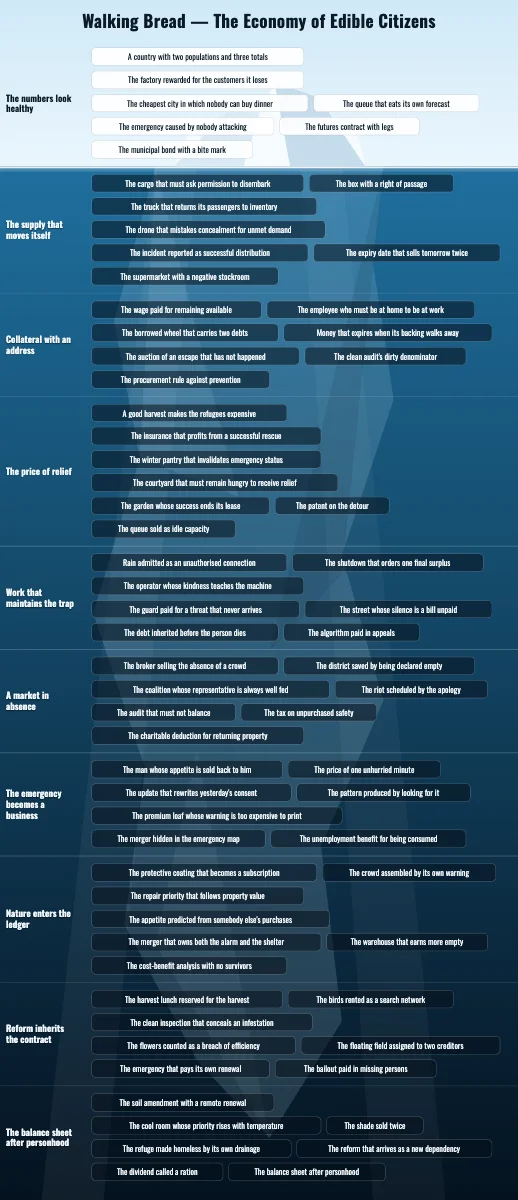
Alex Boya’s Bread Will Walk / Walking Bread / The Mill universe. 70 economic fables, each with two deeper consequences: 210 connected topics across ten depths. Tap each entry for all three layers. Contracts, food distribution, labour, property, surveillance, ecology and institutional reform. Expanded fictional institutions and events, not claims about real-world economics or a list of scenes in the short. Illustrated companion: https://themill.world/iceberg-the-economy-of-edible-citizens/ . Film artwork: https://mediaspace.nfb.ca/epk/bread-will-walk/
Depth levels
- Levels, top to bottom: The numbers look healthy, The supply that moves itself, Collateral with an address, The price of relief, Work that maintains the trap, A market in absence, The emergency becomes a business, Nature enters the ledger, Reform inherits the contract, The balance sheet after personhood
What is on each level
- The numbers look healthy: A country with two populations and three totals (EXPANDED FICTION · Bread Will Walk / Walking Bread / The MillThe census counts a transformed resident once as a person, The factory rewarded for the customers it loses (EXPANDED FICTION · The Mill's emergency contract pays by households reached, not meals safely completed. When a customer transforms, The cheapest city in which nobody can buy dinner (EXPANDED FICTION · Official food inflation falls after transformed bodies enter the emergency supply index. Wages and relief payments stop rising, The queue that eats its own forecast (EXPANDED FICTION · Distribution software sends extra loaves where hungry crowds are predicted. Crowds follow the delivery notifications. Tess discovers that, The emergency caused by nobody attacking (EXPANDED FICTION · At six each morning, the city publishes the number of dangerous encounters prevented. One morning the figure doubles, The futures contract with legs (EXPANDED FICTION · A trader sells next month's reserve capacity against residents counted today. When those residents relocate, The municipal bond with a bite mark (EXPANDED FICTION · A city's loan covenant requires a minimum nutritional reserve. Officials meet it by including living bread residents
- The supply that moves itself: The cargo that must ask permission to disembark (EXPANDED FICTION · A ship carries beans, pump parts and a cabin of peaceful bread passengers. Freight clears in minutes; passengers need proof of food, The box with a right of passage (EXPANDED FICTION · A freight container may cross three districts without opening; a bread person must submit to inspection at each boundary. Ada rents a container for, The truck that returns its passengers to inventory (EXPANDED FICTION · A semi-automated delivery truck has a return-to-depot function whenever its load differs from the manifest. Ada and three bread, The drone that mistakes concealment for unmet demand (EXPANDED FICTION · Relief drones use thermal movement and open-space recognition to select drop sites. Bread residents shelter beneath cooler, The incident reported as successful distribution (EXPANDED FICTION · A bread resident disappears during a crowded relief handoff. The delivery counter records a completed allocation, The expiry date that sells tomorrow twice (EXPANDED FICTION · A distributor labels a reserve as expiring tonight, The supermarket with a negative stockroom (EXPANDED FICTION · A shop reports no ordinary food in storage while holding vouchers redeemable against municipal reserves. Its balance sheet calls the
- Collateral with an address: The wage paid for remaining available (EXPANDED FICTION · Bread residents receive rent credit for sitting eight hours inside monitored shelters. Officially they reassure the public that protection, The employee who must be at home to be at work (EXPANDED FICTION · The shelter's doors are leased with the same contract that employs Ivo to maintain them. When he challenges the location tags on, The borrowed wheel that carries two debts (EXPANDED FICTION · A courier lends her cargo bicycle to carry an injured bread resident through a narrow passage. The delay costs her an automated delivery, Money that expires when its backing walks away (EXPANDED FICTION · The city issues a stable meal credit backed by emergency reserves. Its definition includes bread people who never consented to, The auction of an escape that has not happened (EXPANDED FICTION · Confiscated cars are sold with their onboard route histories. A buyer purchases an unusable van because it once carried bread, The clean audit's dirty denominator (EXPANDED FICTION · The Mill reduces reported injuries by adding transformed customers to the workforce denominator without adding their harms to the numerator, The procurement rule against prevention (EXPANDED FICTION · Kitchens request funds for regular vegetables. Procurement rejects the expense because their mandate covers emergency response only. An
- The price of relief: A good harvest makes the refugees expensive (EXPANDED FICTION · Sera's fields produce a reliable crop. Ordinary food reduces pressure on bread people, The insurance that profits from a successful rescue (EXPANDED FICTION · An insurer compensates lenders when a registered bread resident goes missing. A rescue can therefore pay better than continued, The winter pantry that invalidates emergency status (EXPANDED FICTION · Households preserve ordinary vegetables together to reduce winter hunger around their bread neighbours. The first full pantry, The courtyard that must remain hungry to receive relief (EXPANDED FICTION · A courtyard qualifies for food drops according to observed crowd size. Residents stagger collection to protect bread, The garden whose success ends its lease (EXPANDED FICTION · A vacant lot is licensed for cultivation until it regains economic value. Refugees and hungry neighbours clear rubble, The patent on the detour (EXPANDED FICTION · A route service patents a method for avoiding crowd convergence. Public kitchens must pay to distribute the detour map that their own schedules made, The queue sold as idle capacity (EXPANDED FICTION · An advertising contractor rents the attention of people waiting for food. Faster distribution reduces impressions
- Work that maintains the trap: Rain admitted as an unauthorised connection (EXPANDED FICTION · A refuge collects rainwater for washing. The utility charges a lost-revenue fee: lower purchases weaken the bond financing the mains, The shutdown that orders one final surplus (EXPANDED FICTION · Tess finds that the Mill's emergency shutdown protocol requires enough reserve stock to cover the interruption. The reserve model, The operator whose kindness teaches the machine (EXPANDED FICTION · An operative quietly delays deliveries near bread shelters. The scheduling model learns from his overrides and labels those streets, The guard paid for a threat that never arrives (EXPANDED FICTION · A guard's contract rewards interceptions of dangerous transformed bodies. The bread residents remain peaceful. To meet the target, The street whose silence is a bill unpaid (EXPANDED FICTION · Traffic vanishes from a block after a fuel contractor cuts service. Bread residents gain a quiet crossing. Ivo warns that the same, The debt inherited before the person dies (EXPANDED FICTION · A transformation triggers an insurance event that transfers a resident's debts to relatives, The algorithm paid in appeals (EXPANDED FICTION · An eligibility vendor charges a low screening fee and a larger fee for processing challenges. Its false rejections become a second revenue stream
- A market in absence: The broker selling the absence of a crowd (EXPANDED FICTION · A broker sells bread refugees forecasts of streets where hungry people are least likely to gather. He secretly buys advertising space, The district saved by being declared empty (EXPANDED FICTION · Bread refugees find that a district marked uninhabitable receives no patrols or reserve inspections. They repair rooms quietly. When a, The coalition whose representative is always well fed (EXPANDED FICTION · An emergency council reserves a seat for the hungry living and one for bread residents. Meetings include a substantial meal, The riot scheduled by the apology (EXPANDED FICTION · After a failed distribution, the council announces compensation at a single desk. The invitation draws hungry households into the narrow street, The audit that must not balance (EXPANDED FICTION · Tess's final audit removes living bodies from reserve collateral. The accounts no longer balance. A consultant proposes adding the estimated value, The tax on unpurchased safety (EXPANDED FICTION · A district installs public shade, reducing demand for private cooling. A revenue-sharing agreement obliges the city to compensate the cooling, The charitable deduction for returning property (EXPANDED FICTION · A creditor relinquishes claims on registered bodies and deducts their estimated value as a donation. Higher valuations produce
- The emergency becomes a business: The man whose appetite is sold back to him (EXPANDED FICTION · Ivo's meal app offers increasingly urgent recommendations near bread shelters. It infers hunger from missed purchases and long shifts, The price of one unhurried minute (EXPANDED FICTION · A clinic trials a quiet waiting room with ordinary soup before interviews. Hungry visitors become less hurried and more able to discuss choices, The update that rewrites yesterday's consent (EXPANDED FICTION · A distribution app changes its terms so that accepting a relief delivery also enrols the household in reserve monitoring. Existing, The pattern produced by looking for it (EXPANDED FICTION · Reports claim bread residents gather before food disturbances. Tess compares camera locations and finds cameras concentrated at kitchens, The premium loaf whose warning is too expensive to print (EXPANDED FICTION · A distributor introduces colour-coded packaging to distinguish product batches. A low-cost run omits the code to save, The merger hidden in the emergency map (EXPANDED FICTION · Two suppliers claim competition because they sell different services: food delivery and shelter access. Their route maps reveal that each, The unemployment benefit for being consumed (EXPANDED FICTION · A benefits schedule recognises loss of employment only after the recipient becomes unavailable for work. Transformed residents are
- Nature enters the ledger: The protective coating that becomes a subscription (EXPANDED FICTION · A company sells a temporary coating that reduces visible crumbling on bread bodies. Ada finds it useful for one exposed journey, The crowd assembled by its own warning (EXPANDED FICTION · A neighbourhood alert says hungry residents are approaching a bread shelter. People nearby open the message, The repair priority that follows property value (EXPANDED FICTION · After a storm, an algorithm prioritises repairs by expected economic loss. A warehouse of empty containers ranks above a crowded, The appetite predicted from somebody else's purchases (EXPANDED FICTION · A forecasting tool classifies Ivo as increasingly dangerous because his household buys less food. In fact, The merger that owns both the alarm and the shelter (EXPANDED FICTION · A food-distribution company acquires the firms providing hunger alerts and refuge insurance. Each service remains legally, The warehouse that earns more empty (EXPANDED FICTION · A shortage contract pays the owner for capacity reserved for future emergency stock. Filling the building with ordinary grain would cancel the, The cost-benefit analysis with no survivors (EXPANDED FICTION · A policy report compares the value of meals provided with the administrative cost of protecting bread residents. The model excludes the
- Reform inherits the contract: The harvest lunch reserved for the harvest (EXPANDED FICTION · Field workers are paid after weighing the crop, The birds rented as a search network (EXPANDED FICTION · A contractor tracks gull movements to infer where exposed bread bodies may be hiding. The birds are not trained; their ordinary feeding, The clean inspection that conceals an infestation (EXPANDED FICTION · A museum refuge passes inspection because cleaners seal insects behind display walls before the official visit. The hidden, The flowers counted as a breach of efficiency (EXPANDED FICTION · Sera leaves flowering margins around fields to support pollinators. The emergency yield contract penalises acreage not planted with, The floating field assigned to two creditors (EXPANDED FICTION · A group builds raised growing beds along a wet canal edge, The emergency that pays its own renewal (EXPANDED FICTION · A levy on emergency transactions funds the office deciding whether the emergency continues. Successful prevention reduces the office's, The bailout paid in missing persons (EXPANDED FICTION · A failing reserve fund asks the city to guarantee losses from unlocatable residents. The treasury can preserve pensions only by recognising
- The balance sheet after personhood: The soil amendment with a remote renewal (EXPANDED FICTION · A supplier sells growers a microbial soil amendment with sensors and advisory software. The material remains in the soil after the, The cool room whose priority rises with temperature (EXPANDED FICTION · A heat emergency sends hungry workers and bread refugees toward the same cooling hall. Entry is ranked by measured body, The shade sold twice (EXPANDED FICTION · A city leases tree-lined pavement to cafes whose permits promise public access. During a hot week, The refuge made homeless by its own drainage (EXPANDED FICTION · Ivo pumps water from a cellar shelter, keeping bread residents away from damp floors. Across the block, The reform that arrives as a new dependency (EXPANDED FICTION · The council purchases a unified platform to remove contradictory records. It makes one decision propagate instantly across housing, The dividend called a ration (EXPANDED FICTION · Residents receive food credits financed by profits from the reserve market. The credits make opposition materially painful: ending body-backed, The balance sheet after personhood (EXPANDED FICTION · Tess produces two final accounts. The first shows a poorer city because living bodies have been removed from collateral. The second shows more
